Skip to content
Protocol coverage · August 2026

18 protocols, across 9 layers. 5 verifiable maturity levels.

Agentic commerce is standardizing in public and halfway. We publish the real status of each protocol - what we use today, what's in Sandbox, and what we haven't implemented - because integrating on top of a bundled promise is how quarters get lost.

Each protocol's status is resolved against the platform's capability registry, not hand-copied onto this page.

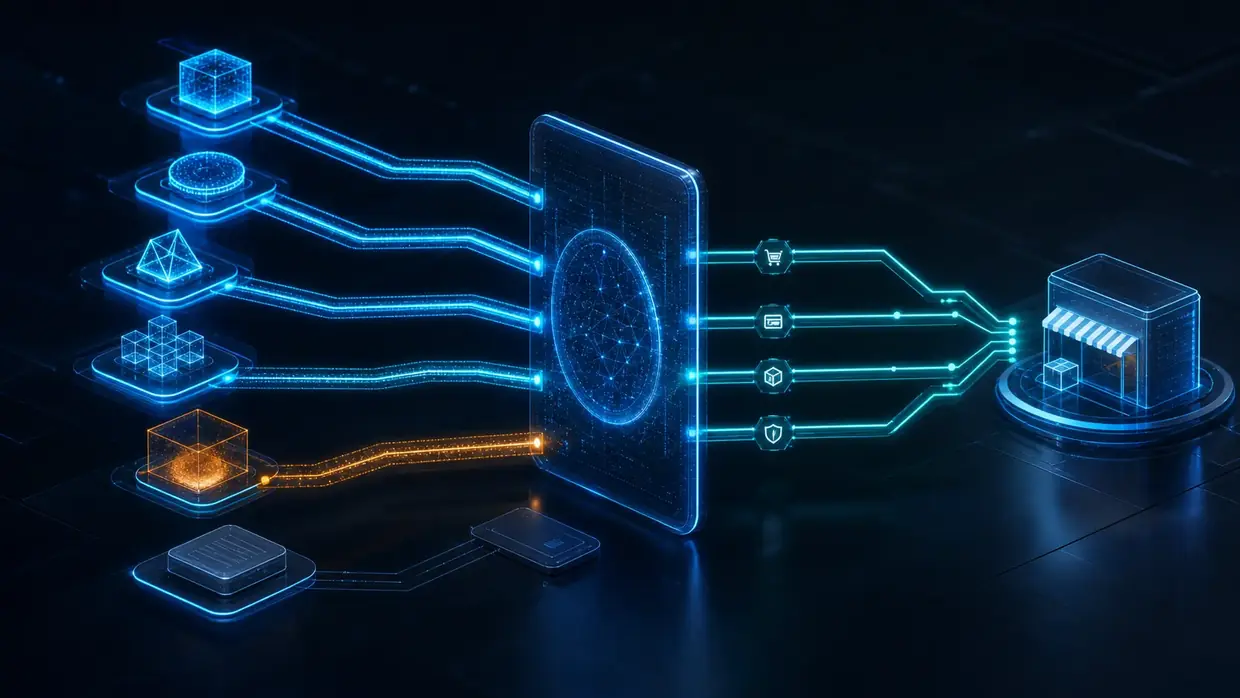
Several protocol channels with different levels of connection cross an interoperability layer and end in normalised tools for a single merchant.
ProtocolsProtocols solve different jobs and don't share the same maturity level.The common layer keeps store operation stable: channels in production flow end-to-end; the rest keep visible limits.
Protocol by protocol

What each one solves, and where we stand.

The order reflects usefulness today, not expectation. A protocol with strong backing and an open spec is still a protocol you can't yet use in production.

MCP

Model Context Protocol
Production
AUTHORAnthropic
TRANSPORTStreamable HTTP
SPECmodelcontextprotocol.io
WHAT IT SOLVES

The standard protocol by which an agent discovers tools, invokes them, and reads structured resources. It's the transport: it defines how you talk, not what you buy.

WHERE WE STAND

Transport, tool listing and tool invocation implemented. Every connected store is exposed as a multi-tenant MCP server at POST /{store-slug}/mcp over Streamable HTTP transport, and it is the path all agentic traffic goes through today. What a given store actually serves depends on its own configuration: call `tools/list` and read the answer.

WebMCP

Web Model Context Protocol
Coming Soon
AUTHORGoogle (Chrome) and Microsoft (Edge)
VERSIONW3C Community Group draft
SPECwebmachinelearning.github.io/webmcp
WHAT IT SOLVES

Turns any website into an MCP server: the browser exposes forms, buttons, and storefront data as tools an agent can use. It's what lets checkout close inside the store instead of returning a link.

WHERE WE STAND

The bridge bundle is served publicly. Current tests mock navigator.modelContext; a verifiable run against a browser with native support is still needed before calling it production.

UCP

Universal Commerce Protocol
Production
AUTHORGoogle, Shopify, and a consortium of 30+ companies
VERSION2026-04-08 (Phase B)
SPECucp.dev/latest
WHAT IT SOLVES

The commerce semantics layered on top of the transport: checkout sessions, identity binding, order management, and returns. UCP is to MCP what REST is to HTTP.

WHERE WE STAND

The public capabilities surface responds in production and declares UCP enabled. This confirms deployment, not full coverage of every function in the spec.

x402

Payment over HTTP 402
Sandbox
AUTHOROpen standard
VERSIONOwn binding
SPECOnboarding guide available on request
WHAT IT SOLVES

Reuses the HTTP 402 status code so a server can require payment within the HTTP exchange itself, without sending the agent to a separate flow.

WHERE WE STAND

The rail is deployed and its health is published in production. Availability per scheme and network should be checked before integrating.

A2A

Agent-to-Agent Protocol
Production
AUTHORGoogle
SURFACEAgent Card
STATUSDiscovery deployed
WHAT IT SOLVES

Direct communication between autonomous agents: a buying agent negotiates with a selling agent without going through a human interface.

WHERE WE STAND

The public Agent Card responds in production. This enables agent-to-agent discovery; it doesn't mean autonomous price negotiation is available.

AP2

Agent Payments Protocol 2
Experimental
AUTHORGoogle
ENVIRONMENTDemo
STATUSBridge active in sandbox
WHAT IT SOLVES

Payment mandates with cryptographic verification: the user pre-authorizes the agent to spend up to an amount, with a signature and expiration, and the agent buys within that limit without additional confirmation.

WHERE WE STAND

The bridge is active in the demo environment. It is not presented as a production rail and doesn't replace the authentication and consent requirements that apply to payment.

Protocol-agnostic core

No integration depends on a protocol arriving on time.

The core doesn't know which protocol a request came in through. Rules, limits, and evidence apply the same whether it arrives via MCP, REST, or a binding that doesn't exist yet. That's what lets us have protocols at different stages without blocking anyone: when they advance, they turn on as an extra layer, and what already works keeps working.

01
DeployedMCP, UCP, and A2A discovery
production
02
In validationAP2 in demo, x402 deployed but with no merchant settleable, and WebMCP pending a real native browser
sandbox / coming soon
03
Before integratingCheck surface, flags, network, and commercial scope
check status
Next step

If you're integrating, start with what's in production.

MCP covers discovery, catalog and cart on all five integrated platforms. That is the capability, not the deployment: which merchants are actually connected, and on which platform, is published at /.well-known/merchant-index.json. Everything else layers on top without rebuilding the integration.

18Total protocols
8In production
2Sandbox
9Layers
ProductionSandboxComing Soon
0

Layer 0 Structured Web Access

Discovery and data access layer for agent navigation

3 protocols
WebMCPW3C CG Draft (27 Mar 2026)
Coming Soon
W3C Community Group

W3C Community Group standard for agent-to-web interactions via browser APIs

Where we stand: Bridge served, native mode unvalidated: the four bundles are served and their sha256 matches the build, but our E2E suite injects a mocked `navigator.modelContext` and there is no run against a browser with real support.

B2BB2CD2C
DiscoveryW3C Standard
llms.txt
Production
Jeremy Howard / Answer.AI

Machine-readable format for LLM agent discovery and capabilities

B2BB2CD2C
Discovery
NLWeb
Coming Soon
Microsoft (R.V. Guha)

Open protocol and tools for building conversational interfaces for any website using Schema.org, MCP and LLMs

Where we stand: Deployed on our side: `POST /{store}/ask` responds and the search pipeline (pgvector retrieval plus re-ranking) is implemented. We cannot claim it indexes or answers — measured 2026-09-03, that route returns VECTOR_DB_UNAVAILABLE because the embedding step is failing upstream, and the `nlweb_ask` tool responds on no MCP surface.

B2CD2C
MCP ToolDiscoverySSE
1

Layer 1 Agent-to-Tool Infrastructure

Core tool integration protocol with standardized JSON-RPC 2.0 interface

1 protocol
Model Context Protocol2025-11-25 (SDK 1.29.0)
Production
Anthropic

Open standard for agent tool integration with standardized JSON-RPC 2.0 interface and tool registration

B2BB2CD2C
MCP ToolDiscovery
2

Layer 2 Agent-to-Agent Coordination

Multi-agent messaging, task orchestration and interoperability

1 protocol
A2A Protocol
Production
Google / Linux Foundation

Open protocol enabling AI agents to discover each other, negotiate communication formats, and coordinate tasks across vendors and platforms

B2BB2C
SSEDiscovery
3

Layer 3 Agent-to-User Interaction

Real-time human-in-the-loop flows with state sync and cryptographic confirmation

2 protocols
AG-UI Protocol
Production
CopilotKit

Open, event-based protocol that standardizes how AI agents connect to user-facing applications with streaming, state patches and tool calls

B2BB2CD2C
SSEDiscovery
A2-UI Protocolv0.8
Planned
Google

Agent-to-UI: an open Google protocol for agents to describe rich, interactive UI declaratively in JSON, rendered natively by the client. We do not serve it. Our trust component vocabulary is published transport-agnostically at /.well-known/trust-components.json and is served today over MCP Apps

B2BB2CD2C
MCP ToolDiscovery
4

Layer 4 Commerce Discovery & Checkout

Multi-protocol payment initiation and checkout flows for agentic commerce

3 protocols
ACP2026-01-30
Sandbox
OpenAI + Stripe

Open standard for programmatic commerce flows between buyers, AI agents, and businesses with session resume and display context

B2BB2C
MCP ToolDiscovery
AP20.1 (pre-FIDO donation)
Experimental
Google → FIDO Alliance

Open protocol for secure agent payments via signed Mandates. Donated by Google to FIDO Alliance on 2026-04-28 — currently under review by the Agentic Authentication Technical Working Group, pending external (FIDO) ratification (expected Q3-Q4 2026).

B2C
MCP ToolDiscovery
UCP2026-04-08 (Phase B)
Production
Google + Shopify et al.

Universal open-source standard for agentic commerce built on REST and JSON-RPC with native A2A, AP2 and MCP support, backed by 20+ global partners

B2BB2C
MCP ToolDiscovery
5

Layer 5 Human-Confirmed Payment Execution

W3C browser-native APIs that bridge agent-initiated checkout and settlement — requires a human present in the browser to confirm payment biometrically or via saved credentials

1 protocol
Payment Request APIW3C CR Draft (27 Jan 2026)
Production
W3C

W3C Candidate Recommendation standard that lets merchants accept Apple Pay, Google Pay and saved cards via a browser-native popup. Generates a Stripe PaymentMethod token — zero PAN data stored, PCI DSS scope reduced. Available as a client capability that complements fully-agentic checkout flows.

B2CD2C
W3C Standard
6

Layer 6 Payments Authentication & Settlement

Tokenization and settlement protocols across fiat, stablecoin, and card networks

5 protocols
x4021.0
Sandbox
Coinbase + Cloudflare

Internet-native payments standard built on HTTP 402 for USDC stablecoin micro-transactions between AI agents and APIs

B2BB2C
MCP ToolDiscovery
MCAP
Coming Soon
Mastercard

Mastercard agentic tokenization via Stripe pass-through with RFC 9421 Ed25519 HTTP signatures, consent management, and W3C Verifiable Intent receipts

B2BB2C
MCP ToolDiscovery
VIC
Coming Soon
Visa

Visa Intelligent Commerce with FIDO2 passkeys for tokenized payment flows and recurring subscriptions with trust score boost

B2BB2C
Discovery
MPPdraft-httpauth-payment-00 (18 Mar 2026)
Planned
Stripe + Tempo Labs

Machine Payment Protocol — payment-method-agnostic M2M payments over HTTP 402 + WWW-Authenticate, with native MCP/JSON-RPC transport. Backwards-compatible superset of x402. Submitted to IETF as draft-httpauth-payment-00. Trusteed positions as the trust+policy layer that MPP and ACP need above MCP.

B2B
MCP ToolDiscovery
PayPal
Coming Soon
PayPal

PayPal Orders API v2 with agent settlements, subscriptions, invoicing and dispute resolution via @paypal/agent-toolkit

B2C
MCP ToolDiscovery
7

Layer 7 Trust & Identity Verification

Cryptographic identity proofs and passkey-based merchant verification

1 protocol
FIDO2 / WebAuthn
Production
FIDO Alliance + W3C

Passwordless authentication standard with passkeys for merchant identity, 2FA and Digital Credentials API with mDL / SD-JWT-VC support. The endpoint is deployed; adoption or passkey users cannot be claimed.

B2BB2C
DiscoveryW3C Standard
8

Layer 8 Shopper Context & Personalization

Preference sharing and shopper context across agents and retail platforms

1 protocol
SCP
Production
Retail AI Council

Open standard letting shopper preferences, loyalty and behavioral intent travel safely across agents, channels and retail platforms

B2C
MCP ToolDiscovery

Why multi-protocol?

1

Agent choice

Agents pick the protocol they support. No negotiation, no fallback errors.

2

Revenue maximization

Do not lose sales because an agent only speaks x402 and your store only speaks ACP.

3

Future-proof

New protocols are added via the Plugin Registry. Your integration stays the same.

4

Single integration

One MCP endpoint, all protocols. The Protocol Router handles detection and routing.

Frequently asked questions

How many protocols can a merchant enable?

All supported protocols simultaneously. MCP, UCP, and SCP are in production; ACP and x402 are in sandbox — the x402 rail is deployed, but no merchant has a settleable configuration, so no payment completes over it today; AP2 is experimental; Visa VIC, Mastercard MCAP, and PayPal are coming soon. The Protocol Router selects the best match based on agent capabilities and merchant priority configuration.

Is there a cost per protocol?

Protocol support is included in all tiers. Settlement fees depend on the protocol provider: Stripe for ACP, which is the rail that actually moves money today. For x402 there is nothing to charge for yet, because no merchant has a settleable configuration and the settle route returns `x402_not_configured`.

Can I add a custom protocol?

Yes. The Plugin Registry supports custom adapters. Contact us for Enterprise integration support.

How does protocol detection work?

The Protocol Detector middleware inspects request headers, signatures and body shape to identify the protocol. Each match carries a confidence value; an explicit `X-Protocol` header gives 1.0, and header- or signature-shape inference gives less. Below the detector's threshold no protocol is assumed and the request is handled as plain REST. No manual configuration is needed on the agent side.

Trusteed - Protocol coverage: MCP, WebMCP, UCP, x402, A2A, and AP2